2012-06-28

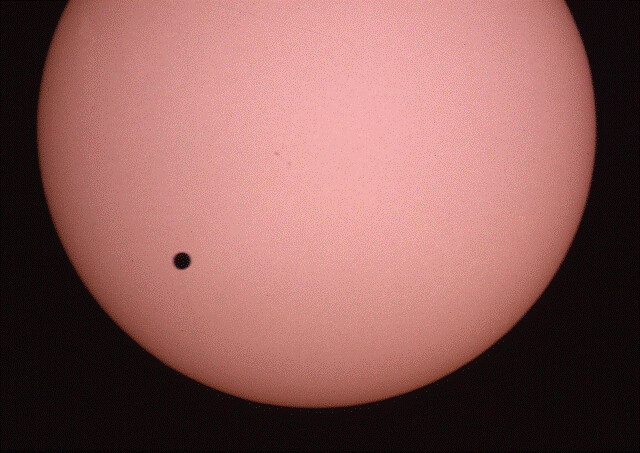
Venus Transit (2012): Some collected images

Here are my images of the transit (first two). They are not great the setting was not appropriate for astroimaging as I was participating in a public observing event.
I was able to catch these images in between observers:

Through my cams' zoom only!
You can see Venus in the upper centre!
Telescope eyepiece view @ 85x

And here's an image by my collaborator astroZ


Saida, Al Janoub; astroZ

2012-05-28

Transit of Venus (2012)

Hello again :D

    WARNING    Before reading the article, please be warned that looking at  the Sun without appropriate precautions (using solar filters, viewers, etc...) may & will cause partial or complete damage to your sight. Please take appropriate measures in advance &/or participate in a local astronomy group that takes precautions on your behalf by letting you view the transit through its equipment. You have been warned!!!

    A rare event that comes in pairs every 120 years, more or less, occurred on June 8, 2004. This rare event is going to occur in a couple of days as the second of the 2004/2012 pair which will not repeat until the year 2117. In other words, this rare celestial happening is the last one to occur in our lives; no one might be able to witness it again, unless science offers a way to extend the human life span.
This special event is the Transit of Venus (i.e; transit of the planet Venus in front -from our viewpoint- of the Sun). The two events are separated by about 8 years. This is characteristic of such a phenomenon which occurs twice every 120 years, as I've mentioned above. That is, it occurs in pairs (e.g; 2004/2012). The next pair will start in the year 2117.

Transit of Venus 2004; astroZ (http://flic.kr/p/ac4z8C)

2012-04-22

Catch a Shooting Star!

Last night was the peak of the Lyrid meteor shower. Having never photographed a meteor, I thought this would be a good chance to try to capture a picture of one. And guess what, I got one! Here's the photo:


The picture shows ten minutes worth of star trails and the meteor's streak in the center. So how can you take such a picture? Well, I haven't done much reading about optimal strategy to capture a meteor, but I thought that I'd share my experience on how I managed to take this particular photo.

2012-04-21

Circumpolar Trails and Helpful WebPages on Trails

I recently took another photo of star trails from my home in Saida. The result is shown below:


As you may have noticed, the trails make circles around a point near the center. This point is the north celestial pole, and close to it is the bright star Polaris or the North Star. Polaris is not precisely at the north celestial pole, so it too makes a small trail. This is my first picture of such "circumpolar" trails.

2012-04-15

Close Encounters: Moon and Planets

Every so often, the Moon, planets, or both appear close to each other in the sky. Such an event is called a conjunction and presents a nice and simple astrophotographic opportunity. Photographing such events only requires only a camera and tripod, and because the Moon and planets can be easily seen from the city, a dark site is not required. Any sky calendar will tell you when these events will happen, and so checking these each month will help you plan these photos.
So what are some tips for photographing these events? Here's a few:
-          Try a low ISO as this will minimize noise. You don't need a high ISO setting, as exposures of only a second or so are all that is generally required for these bright objects. You won't gain much from a high ISO except to shorten an already short exposure.
-          Try stopping the camera lens down a bit more than its minimum f-ratio. You don't need small f-ratios because again, the moon and planets are bright. Increasing the f-ratio will help you get a sharper image.

2012-04-12

Stellar Trails

One of the simplest, easiest, and most rewarding astrophotos you can take are star trails photos. All that is required is a camera capable of relatively long exposures, a tripod, cable release, a free computer program, and a moderately dark site.

So what are trails and star trails photos exactly?

Well, as I mentioned in the Camera and Tripod Astrophotography post, trails in any other picture than star trails pictures are a problem for long exposure astrophotography. Trails are caused by the slow apparent movement of stars (or other objects in the sky) due to the Earth's rotation. The reason trails appear in longer exposures of around 20-30 seconds (depending on the focal length lens you're using) is the same reason the sun rises, appears to move across the sky during the day, and then sets. As the Earth rotates, the stars slowly shift to different positions in the sky, and as they move they make lines or trails in your picture.

But, who said trails are not nice looking? Indeed, a star trails picture aims at showing the trails themselves!   

To take a star trails photo, first set up your camera and tripod at your chosen site, and focus your camera on the sky as described in the Camera and Tripod Astrophotography post. Next, aim your camera at the portion of the sky you want to photograph. Aiming for a star trails photo shouldn't be too difficult, as you can catch trails practically anywhere in the sky, as long as you can see stars there. It is nice to try to include a few bright stars in your picture or some terrestrial scenery.

2012-04-09

Catch Mars this Month

     Last month, Mars reached opposition, coming closer to earth than it has been for a while. This month, Mars continues to shine brightly in the sky, but it is quickly fading as it moves farther from Earth. At opposition, Mars grew to a diameter of about 14 arc-seconds, and now is still at a respectable 12''. By the end of April, however, Mars will be around 10'', and in one more month, it will lose another 2''. So what does this mean? Well, if you have a telescope and want to see Mars, you'll want to catch it soon while it's diameter is still large enough to show surface detail. The amount of detail you can see also depends on how big your telescope's aperture is.

     I could see and photograph these surface features with my 8 inch Schmidt Cassegrain telescope in late February. Here's the picture taken with a webcam (more on webcam astrophotography later). Notice the dark, so-called "albedo" features on the Red Planet's surface. You can also faintly see the white polar ice cap on the upper-left of the red planet's disc: